Lauren Greenfield
The introduction video on Greenfield's website certainly is though provoking. It is is to see what Lauren is depicting in her work. Greenfield's photographs attack the American idea of beauty, money, and culture. Images of extremely thin women and post-cosmetic surgery individuals show Greenfield's critique of the concept of beauty in the modern world. Greenfield also show images of teenagers who are growing up in this consumer culture and how money has truly become a major problem for those growing up in this era.
Thursday, May 19, 2011

Andy Reynolds
Andy Reynolds' Website
This photographer makes good on the diptych. Many of the images found in Book One create a bizarre match up for images. Although I cannot place one distinct theme that runs throughout the piece, there are hints of social critique on American culture and consumerism. One of the most bizarre diptychs is that of two squirrels mating on a copier and the man standing in the corner of an elevator while the woman looks directly forward. I can only think that Andy Reynolds is creating a contradiction between these photographs. While the squirrels are free to mate in the setting of an office, men must subdue their instincts and avoid unnecessary contact. Reynolds' use of the diptych in this book showed me a new level of use for this format.
This photographer makes good on the diptych. Many of the images found in Book One create a bizarre match up for images. Although I cannot place one distinct theme that runs throughout the piece, there are hints of social critique on American culture and consumerism. One of the most bizarre diptychs is that of two squirrels mating on a copier and the man standing in the corner of an elevator while the woman looks directly forward. I can only think that Andy Reynolds is creating a contradiction between these photographs. While the squirrels are free to mate in the setting of an office, men must subdue their instincts and avoid unnecessary contact. Reynolds' use of the diptych in this book showed me a new level of use for this format.
Tuesday, April 26, 2011
Kinetic Sculpture
I recently came across a very interesting branch of artwork. Kinetic sculpture is moving sculptures that depend on motion for the effect. Often these sculptures are simplistic and wind powered but they can be made to be very complex and mimic more intricate designs in nature. Reuben Margolin designs kinetic sculpture that mimics waves and other natural designs. His designs are very interesting and his work shows a level of dedication and thought that goes into each final design.
BMW has also designed a complex computer controlled kinetic sculpture that has suspended glass spheres attached to filaments that rise and fall and can form into complex designs like that of a car. Kinetic sculpture artists have a lot to account for. Every detail matters and any mistake could bring a quick end to the project.
Thursday, April 14, 2011
Matthew William Robinson
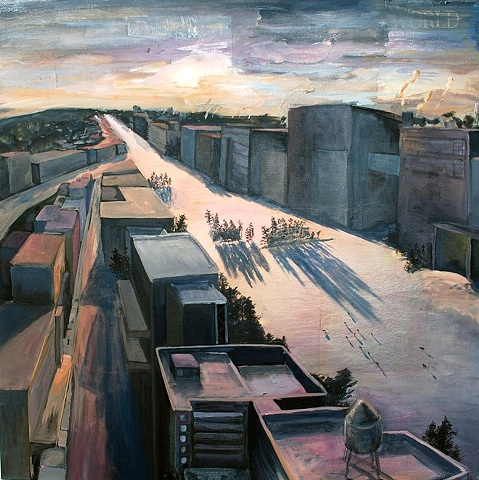
I recently stumbled across this artist on the internet and thought that his work was rather interesting. His paintings primarily deal with desolate and broken environments which seems to be reflective of dystopia. He explains that his work deals with the cyclical pattern of humanity and human understanding. He critiques that "It is de-evolution, in the need to ‘move forward’ humanity blindly takes shortcuts at the expense of health, environment, wellbeing and happiness." This is in a very simple way dystopia. His works all seem to possess this quality as well. For example this painting below shows the crowding of nature by the modern landscape.
The artwork of his collage series also highlights dystopia in a very unique way. His work can be found here. http://matthewwrobinson.com/section/169077_Painting_Collage_2009_10.html
 |
| http://matthewwrobinson.com/artwork/1327990_Untitled_Wolves.html |
Thursday, April 7, 2011
A Visit to the Home of Ansel Adams
Ansel Adams is often regarded as one of the most influential photographers of the modern era. However, it is comforting to know that he too stumbled into his profession as a photographer. He was not formally trained as a photographer and many of his most famous works happened as chance. While Adams certainly had a good eye for his subject, his pictures were often taken by chance. Adams just happened to be in the right place at the right time. It is also important to note that Ansel Adams darkroom was really no more outfitted than the capabilities available to every photographer in software such as Photoshop and Aperture.
Tuesday, March 15, 2011
Bruce and Tamy Leventhal
While normally I am not a fan of the cliche pictures, sometimes the pictures can be done right. Bruce and Tamy Leventhal, a couple from Minneapolis, has done nature photography well. There is even a sense of artistry in their work. Their work can be found here. [Link] The two photographers are interviewed by the St. Croix Press here. [Link] Their work has led them to shoot nature and cultural photography. In many of the images their is a true sense of utopia that is reflective of the work of the Hudson River School. Bruce comments that his work is more technical where as his wife's work is often more emotive. Images of the couples trip to Kenya, which shows a more cultural focus can be seen here. [Link] What is important is the photographers comment that their style of photography is often driven by the equipment that they carry and that having the right tools for the job effects each picture. While I often find that nature photography becomes cliche I see a new sense of appreciation of nature in the works of the Leventhal photographers. There is a sense of emotion and a sense of place that is often lost in other works.
Wednesday, March 2, 2011
Banksy: Street Artist
Banksy's Website
Banksy is an anonymous English graffiti artist who uses street art to critique modern society. Banksy displays his art on public walls and often even build prop pieces. Banksy adresses several themes in his body of work. Through graffiti art Banksy makes statements that are anti-war, anti-capitalism, anti-fascism, anti-authoritarian, and often existential. Banksy's work was documented in the 2010 documentary titled Banksy: Exit Through the Gift Shop.
 Banksy's work shown to the left depicts a naked man hanging from the window of a sexual health clinic in Bristol. This work was made using stencils and painted on an actual clinic wall. The city council has decide to allow the work to say.
 The work on the right depicts a child wearing a large gas mask. This image is overtly anti-war. Anti-war sentiments are running strong these days in the public. On February 28th, I attended a David Gray concert, and he said while sitting at the piano: "These days we invade countries smaller than this piano."While anti-war feelings have been taken up by the public, the world is still at war.
Banksy's anti-capitalism work can be seen through the images like the one below. The work regarding capitalism raises good questions in the viewer. Is this all that life is about? Is our society ruining the environment? etc.

 Banksy's work is growing in popularity and he is definitely being noticed. Will his work spark some change in our behaviors?
Banksy is an anonymous English graffiti artist who uses street art to critique modern society. Banksy displays his art on public walls and often even build prop pieces. Banksy adresses several themes in his body of work. Through graffiti art Banksy makes statements that are anti-war, anti-capitalism, anti-fascism, anti-authoritarian, and often existential. Banksy's work was documented in the 2010 documentary titled Banksy: Exit Through the Gift Shop.


Banksy's anti-capitalism work can be seen through the images like the one below. The work regarding capitalism raises good questions in the viewer. Is this all that life is about? Is our society ruining the environment? etc.


Monday, February 21, 2011
Recreating The Past With Legos
Please check out the following links before continuing:
http://www.oddee.com/item_96540.aspx
http://www.flickr.com/photos/balakov/sets/72157602602191858/
These two artists take celebrated artwork and recreate the images using legos. The first artist Marco Pece is an italian photographer who has chosen to recreate paintings through legos and only using legos as backdrops for his images. This work recreates DaVinci's Last Supper, Grant Wood's American Gothic and other famous paintings in legos. The second artist, who has not supplied a real name on flickr, Balakov takes historical photographs and recreates the scenes using legos and other materials.
Using only legos to create historical images in many ways is a very difficult thing to do. Setting up an appropriate background and recreating the lighting and mood of the photograph or work is not easy. For example, Balakov's setup for Behind the Gare Saint-Lazare may seem like a easy work to reproduce. However, Balakov must manage lighting and recreate realistic shadows and reflections using legos.
See orignal work here.
See lego recreation here.
See setup shot here.
While these works can be created, it leaves the viewer wondering what this world would be like if we all looked the same. Facial expressions and distinct individual features also cannot be recreated. While you look at Afghan Girl (Sharbat Gula) there is a distinct tone of sadness in her face. This just simply cannot be recreated, especially with legos (see here).
While this makes for a very interesting concept, ultimately recreating any image ultimately leaves something out that the original possessed: a sense of time, place, and mood.
http://www.oddee.com/item_96540.aspx
http://www.flickr.com/photos/balakov/sets/72157602602191858/
These two artists take celebrated artwork and recreate the images using legos. The first artist Marco Pece is an italian photographer who has chosen to recreate paintings through legos and only using legos as backdrops for his images. This work recreates DaVinci's Last Supper, Grant Wood's American Gothic and other famous paintings in legos. The second artist, who has not supplied a real name on flickr, Balakov takes historical photographs and recreates the scenes using legos and other materials.
Using only legos to create historical images in many ways is a very difficult thing to do. Setting up an appropriate background and recreating the lighting and mood of the photograph or work is not easy. For example, Balakov's setup for Behind the Gare Saint-Lazare may seem like a easy work to reproduce. However, Balakov must manage lighting and recreate realistic shadows and reflections using legos.
See orignal work here.
See lego recreation here.
See setup shot here.
While these works can be created, it leaves the viewer wondering what this world would be like if we all looked the same. Facial expressions and distinct individual features also cannot be recreated. While you look at Afghan Girl (Sharbat Gula) there is a distinct tone of sadness in her face. This just simply cannot be recreated, especially with legos (see here).

While this makes for a very interesting concept, ultimately recreating any image ultimately leaves something out that the original possessed: a sense of time, place, and mood.
Tuesday, February 15, 2011
Charles Cohen
Charles Cohen was born in New York, New York in 1968. Cohen attended University of Chicago and graduated in 1990. Cohen then went on to receive a Masters of Fine Arts from the Rhode Island School of Design in 1995. Cohen often deals with the ideas of absence and the presence of absence in his photography. Cohen is most well known for his series "Buff" which took pornographic photos and removed the people in the photos leaving a white void in the photos. The "Buff" series and Cohen's other works allow the viewer to interact with his photography by filling the voids with what each individual thinks should take its place.
Charles Cohen's work can be viewed online: http://www.promulgator.com
Cohen was interview in 2006 by Mark Cooley and a transcript of the interview can be found here: http://newmediafix.net/daily/?p=987.
Cohen explains how absence/presence plays out in his work in three different ways. According to Cohen the first effect is the recognition of the void in the work. The second effect of the void is the "abstract effect" which he describes as any intellectual effect that is had by the viewer. The "reflexive effect" is the final step of interacting with these works. Cohen's work deals with the expectations of the viewer and manipulates the expectations with voids in the photography. This in many ways is a psychological process as the human mind fills in voids to create a full image. Cohen details the differences between his "Buff" series, which deals with lack of emotion, and his "Analog Time" series which deals with real emotion. Cohen does not show the two series at the same time because of confusion that can arise between the two pieces. While "analog time" carries over some of the pieces of "Buff" the statement is different. Cohen describes the interactivity with his work as a type of "co-authorship" which is true interaction with the images. Cohen speaks to the iPod campaign and its use of white voids which allows audience interaction as well. Cohen continues to work with presence and absence of presence in his work and is exploring these concepts in film and sculpture.
Charles Cohen's work can be viewed online: http://www.promulgator.com
Cohen was interview in 2006 by Mark Cooley and a transcript of the interview can be found here: http://newmediafix.net/daily/?p=987.
Cohen explains how absence/presence plays out in his work in three different ways. According to Cohen the first effect is the recognition of the void in the work. The second effect of the void is the "abstract effect" which he describes as any intellectual effect that is had by the viewer. The "reflexive effect" is the final step of interacting with these works. Cohen's work deals with the expectations of the viewer and manipulates the expectations with voids in the photography. This in many ways is a psychological process as the human mind fills in voids to create a full image. Cohen details the differences between his "Buff" series, which deals with lack of emotion, and his "Analog Time" series which deals with real emotion. Cohen does not show the two series at the same time because of confusion that can arise between the two pieces. While "analog time" carries over some of the pieces of "Buff" the statement is different. Cohen describes the interactivity with his work as a type of "co-authorship" which is true interaction with the images. Cohen speaks to the iPod campaign and its use of white voids which allows audience interaction as well. Cohen continues to work with presence and absence of presence in his work and is exploring these concepts in film and sculpture.
Subscribe to:
Posts (Atom)